
May 8, 2026 · Amber Walczuk, BSN, RN, NC-BC · Founder & lead practitioner
The Royal Rife Story: The Forgotten Genius Behind Frequency Therapy
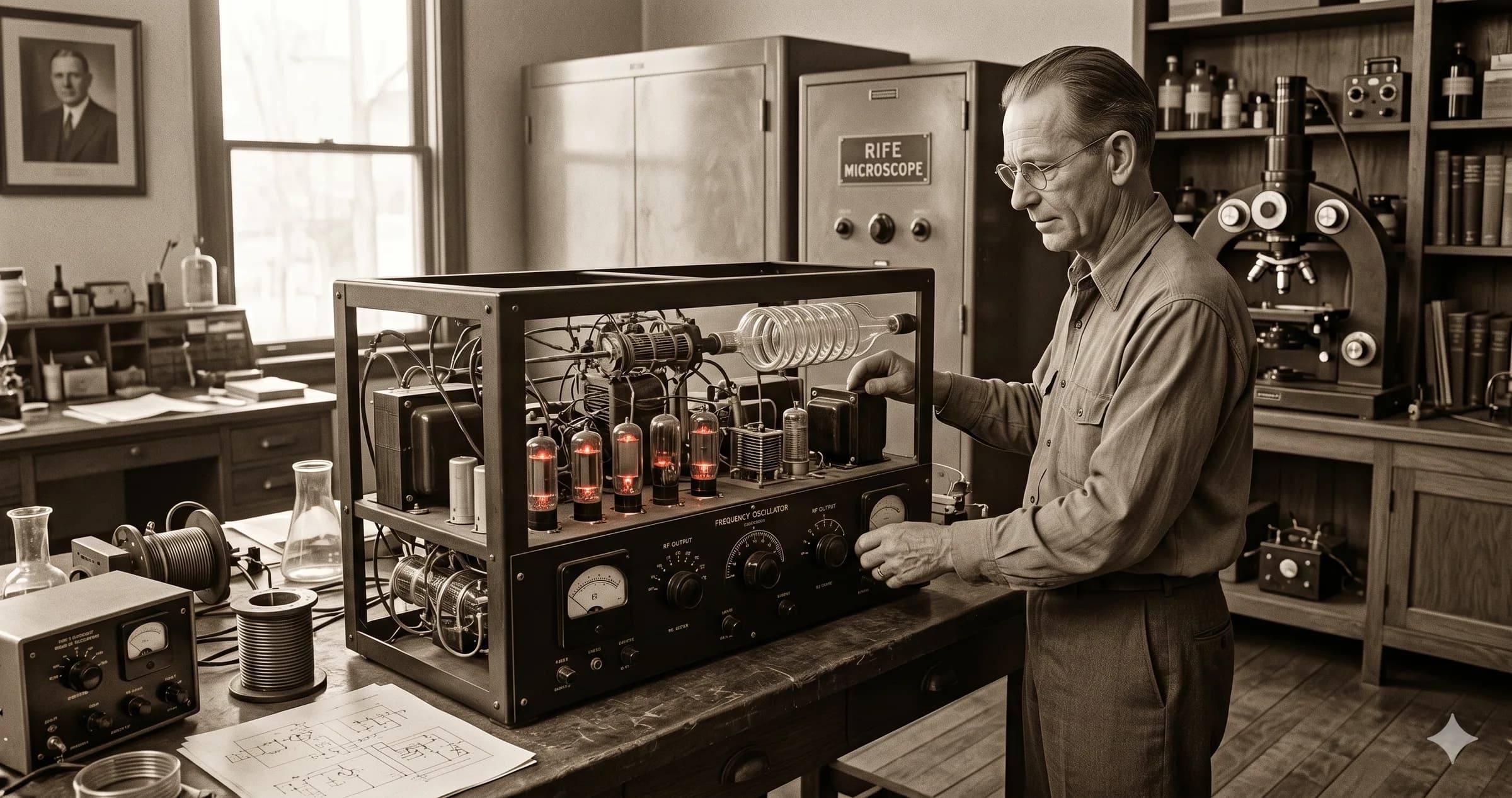
This post is a historical and educational overview. It does not replace care from your healthcare provider. Nothing here is intended to diagnose, treat, cure, or prevent any disease.
If you've ever heard the phrase "frequency therapy" and wondered where the idea actually came from, the answer leads to one of the most extraordinary — and most contested — figures in twentieth-century American medicine.
His name was Royal Raymond Rife. He never finished a formal medical degree, never held a university chair, and died penniless in 1971 at the age of 83. And yet, in the 1930s, working out of a private laboratory in San Diego with funding from a ball-bearing magnate, he built a microscope no one had ever built before, claimed to have identified the cause of cancer, and gathered some of the most respected physicians in California around the idea that disease could be addressed by sound and light rather than scalpels and chemistry.
Then it all unraveled.
I want to walk through his story, because anyone considering frequency therapy today owes it to themselves to understand where it actually came from — and to think carefully about both the parts that are well-documented and the parts that are contested.
The unlikely scientist
Rife was born in 1888 and made his way to San Diego from Nebraska in 1906 (San Diego Reader). He didn't take the conventional academic path. Instead, he learned by working — including a stretch with the legendary German optical company Carl Zeiss. By the 1920s he had taught himself enough across optics, electronics, biology, and chemistry that, as a colleague later put it, he was effectively a one-man research team.
His funding came from an unlikely place: William Timken, founder of the Timken Roller Bearing Company. Rife had reportedly solved a manufacturing problem that saved the company millions of dollars, and Timken returned the favor by underwriting Rife's research for years. Crucially, this meant Rife wasn't financially dependent on pharmaceutical companies or medical institutions — a freedom that almost no medical researcher of his era enjoyed.
The microscope that saw the impossible
In 1933, Rife completed what he called the Universal Microscope — a single instrument made of 5,682 parts that he claimed could magnify living specimens up to 60,000 times (healingscience.bioenergeticspectrum.com). For context: most laboratory microscopes of his day topped out around 2,000 to 2,500 times. Even today, retail microscopes rarely exceed a few thousand magnifications, and high-end optical microscopes might reach 10,000 or 15,000.
But the magnification wasn't the most remarkable part. Modern electron microscopes can achieve much higher magnifications — but to use one, you have to kill and stain your specimen first. Rife's microscope was different: it could observe living organisms in real time.
He achieved this through a technique called dark-field illumination. Most microscopes brighten what you're looking at by staining the sample with dye. Rife was trying to see things smaller than the molecules of stain itself — so staining was useless. Instead, he built an elaborate prism system that fed precise frequencies of light (specific colors — blue, red, green) into the field. Only objects that resonated with that color of light would glow. Everything else stayed black. The organisms simply jumped out of the darkness.
This insight — that specific frequencies of light could selectively interact with specific living things — is what led Rife to his next, much bigger leap.
The hypothesis that changed everything (or nothing)
If specific light frequencies could illuminate specific organisms, Rife reasoned, could specific electromagnetic frequencies destabilize them? Could you find the natural resonant frequency of a pathogen and use it to break the pathogen apart, the way an opera singer can shatter a wine glass?
He called this the Mortal Oscillatory Rate — the frequency at which an organism would self-destruct. And he started building devices to deliver those frequencies.
This is where it gets controversial, and I want to be honest about that.
Rife was convinced cancer had a viral cause. Working with Dr. Arthur Kendall, a Northwestern University bacteriologist who had developed a special medium for cultivating cancer tissue, Rife reportedly made 20,000 attempts before he isolated what he believed was the cause. He named it the BX virus. He claimed he could see it under his microscope, induce tumors in laboratory rats by injecting it, and then collapse those tumors by aiming his frequency device at the same organism.
Mainstream oncology has never accepted Rife's "cancer is viral" thesis as a general explanation, and I want to be clear about that. There are specific viruses associated with specific cancers (HPV and cervical cancer, for instance), but no virus has been identified that explains cancer broadly. Whatever Rife was actually seeing in his microscope — and there are honest debates about that — the framework he proposed has not held up.
The terrain insight (which has aged better)
What's interesting about Rife is that some of his observations have aged better than his theory.
Working alongside Kendall, Rife noticed something now called pleomorphism — the apparent ability of microorganisms to shift form depending on the environment they were in. Most strikingly, he observed that the pH of the surrounding medium dramatically affected what he saw. In an acidic environment, what he interpreted as cancer organisms multiplied rapidly. In a more alkaline, well-oxygenated one, they were harder to find.
From this, he reached a conclusion that sounds remarkably modern: disease isn't just about what's invading you — it's about the terrain it lands in. A body running on poor sleep, depleted minerals, chronic inflammation, and pH imbalance is a different environment than a well-supported one, and the same exposure can produce radically different outcomes.
That insight — symptoms are downstream; terrain is upstream — is essentially what holistic and functional medicine practitioners say today, almost a century later. It's also the thinking behind why we focus on root cause at our clinic.
The 1934 Scripps Ranch trial
In the summer of 1934, Dr. Milbank Johnson — a respected California physician and president of the Southern California branch of the AMA at the time — arranged for a clinical trial at the Scripps Ranch, north of San Diego. Sixteen patients with terminal cancer were referred by the University of Southern California's Special Medical Research Committee to test Rife's frequency device (San Diego Reader).
Pro-Rife accounts say that 14 of the 16 were declared "clinically cured" within roughly 70 days, and that the remaining two recovered shortly after with adjusted treatment. Critics point out that the original trial documentation has been lost or contested, that the criteria for "cure" are unclear, and that the results were never independently replicated.
Whatever the truth of that summer at Scripps Ranch, what happened next is where the story turns dark.
Morris Fishbein and the unraveling
By the late 1930s, Rife's work had attracted national attention. It also attracted Morris Fishbein, the editor of the Journal of the American Medical Association and one of the most powerful figures in American medicine. Fishbein, by various accounts, approached Rife and his associates and offered to buy in. Rife refused.
What followed is the part of the story most often told and most often disputed.
What's reasonably documented:
- A 1939 lawsuit was filed against the Beam Ray Corporation, the company building Rife's frequency devices. Beam Ray won the case in court — but the legal costs bankrupted them (electroherbalism.com).
- William Timken, Rife's longtime financial backer, died around the same period.
- Rife's research notes and microscope components disappeared during this era.
- Rife himself, under enormous stress, descended into alcoholism.
What's contested:
- Pro-Rife sources describe a coordinated suppression campaign — claiming a research lab was burned, that two supporters died under suspicious circumstances, and that Dr. Milbank Johnson himself was found dead in a hotel room the night before he was to deliver a presentation defending Rife's work, with subsequent claims of poisoning.
- Mainstream historians treat these claims with caution. Some events are documented; others have been repeated so often in pro-Rife literature that they've taken on the character of folklore, with original sourcing hard to verify.
I'm laying both sides out because the honest version of Rife's story is that something went very wrong for him in the late 1930s and early 1940s — that much is uncontested — but exactly how much was coordinated suppression versus a more ordinary collision of personality, money, and politics is genuinely unclear. Anyone who tells you they know with certainty is overselling.
The long quiet
Rife was largely forgotten through the 1940s and 1950s. In the 1960s, an engineer named John Crane tried to revive his work by building lower-cost frequency devices. Crane was indicted and imprisoned for selling unapproved medical devices in the early 1960s, in what his supporters considered another chapter of suppression and his critics considered straightforward consumer protection.
Royal Rife died in 1971 at the age of 83. The proximate cause was a combination of alcohol and Valium following an automobile accident — the medication was administered after he was hospitalized. He died penniless.
Why this matters today
You'd think that would be the end of the story, but it isn't. In the decades since, Rife's name has become attached to an entire category of frequency-based devices — some serious, some opportunistic. The FDA has prosecuted multiple sellers for fraudulent cancer claims. Other practitioners have continued careful, narrower work in the bioenergetic-medicine tradition Rife helped pioneer.
The original Universal Microscope, by some accounts, still exists. Original Beam Ray devices occasionally surface at auction. And the underlying questions Rife asked — can specific frequencies interact selectively with biological systems? does the terrain of the body matter as much as what enters it? — have never gone away.
At Eternal Wellness, we use modern TrueRife frequency therapy as part of a broader, conservative wellness approach. We don't make claims that Rife himself made. We don't represent these sessions as cancer treatment, or as a replacement for working with your physician. What we do is offer carefully delivered frequency sessions — often paired with EDS biofeedback testing — as one supportive tool among many in a thoughtful plan that also addresses sleep, nutrition, hydration, and stress.
If you want to know more about how a session actually feels and what we do, the Rife frequency therapy explainer walks through it.
Frequently asked questions
Did Royal Rife actually cure cancer?
That's the contested center of his story. Pro-Rife accounts describe documented cures at the 1934 Scripps Ranch trial. Mainstream medicine does not accept that narrative as established fact. The honest answer is that there were sympathetic physicians of high reputation involved (Milbank Johnson, Arthur Kendall), but the original trial records are incomplete, and no independent group has reproduced the results. We don't make cancer-related claims.
Is the modern "Rife machine" the same thing he built?
No. Rife's original devices were custom-built, used plasma-tube emission, and were enormously expensive to construct. Most modern devices labeled "Rife" use simpler frequency generators — often pad-based — that share the conceptual lineage but not the original engineering. Some are well-built; others are not. We use TrueRife devices specifically because the company has invested in modern engineering and clinical-grade output.
Was Rife really suppressed by the AMA?
Documented: a lawsuit, financial collapse of Beam Ray, lost notes, Rife's personal decline. Less well-documented: claims of coordinated assassinations and lab burnings. The truth is somewhere in between, and reasonable people disagree on how much.
Why does this story still matter?
Two reasons. First, the terrain insight — that the environment your body is running in matters as much as any single intervention — has aged extraordinarily well and is now central to how holistic and functional medicine think about health. Second, the historical pattern of innovative work being marginalized by entrenched institutions is worth being aware of, while also being honest that not every marginalized researcher was a misunderstood genius.
Further reading
- San Diego Reader — Royal Raymond Rife: Into the Micro Beyond — the most thorough mainstream-press biographical piece
- Healing Science — short biography — sympathetic but well-organized timeline
- Electroherbalism — Morris Fishbein and the AMA controversy — pro-Rife perspective on the suppression narrative
- The Royal Rife Story (TrueRife, YouTube) — the company's own narrative video, where parts of this post draw from
— Amber Walczuk, BSN, RN, NC-BC
Want to talk about this? Book a consult.